

How a 4,000-Year-Old Symbol Became My Favorite Way to Understand Healing
What ancient wisdom, solo travel, and inner work taught me about nonlinear growth
Just when you think you’re nearing the center of your growth, life throws you back to the edge—and it feels like you’re starting over. But what if that wasn’t a setback? What if the spiral was the point?
That’s the power of the labyrinth.
Unlike a maze, there are no dead ends. Only turns that lead you inward—layer by layer, deeper into who you’re becoming. It’s an ancient symbol of reflection, transformation, and trust in the path itself.
Healing and solo travel both come with detours.
Over the years, I’ve realized it’s not just about going somewhere new—it’s about learning how to navigate yourself along the way.
This post explores the meaning behind the labyrinth: where it comes from, how it’s used today, and how solo travelers, spiritual seekers, and anyone navigating life’s detours can walk its winding path with more peace and purpose. You’ll also find a list of places to walk a labyrinth in real life, so you can experience it for yourself.
🌀🌊🦋☀️Want to know which symbol mirrors your path?
Take the Travel Archetype Quiz to discover which soul symbol reflects your unique journey.
Each one represents a different phase of transformation—like grounding, flow, release, or rebirth—and helps illuminate your next step.
When you finish, you’ll get a free guide tailored to your symbol, with journal prompts, travel ideas, and more for your inner + outer journey.
The Symbolism of the Labyrinth
You’ve probably seen that squiggly line graphic online—the one meant to show how “healing isn’t linear”:
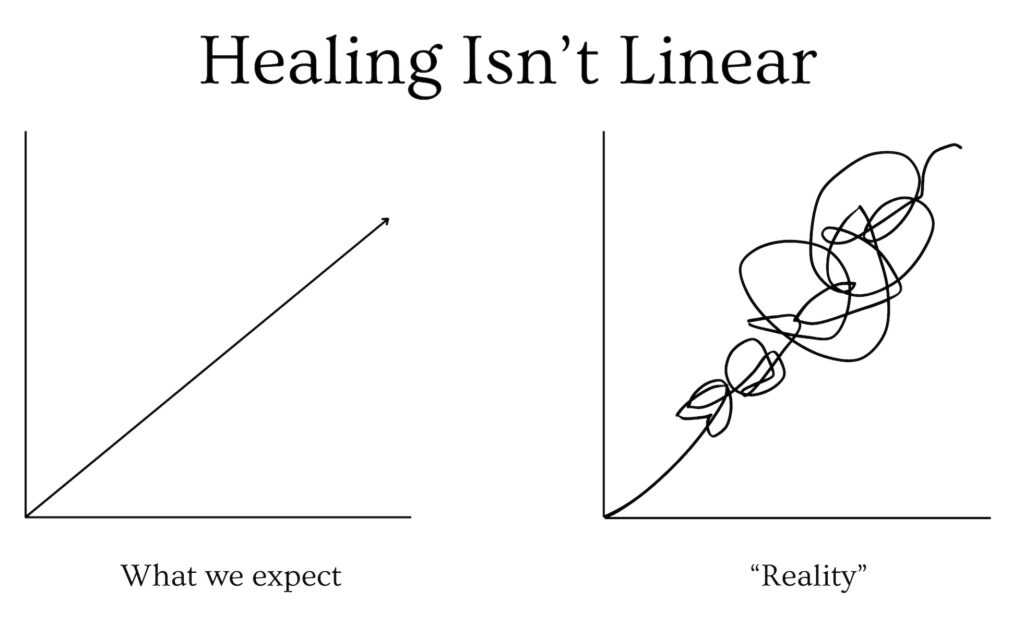
At first, it gave me a little relief. Like, okay, maybe I’m not doing it wrong. But eventually, it just started to feel kind of depressing. It made healing look chaotic and directionless, like the best you can hope for is to keep squiggling until something finally makes sense.
Then there’s the “peeling back the layers of an onion” metaphor:
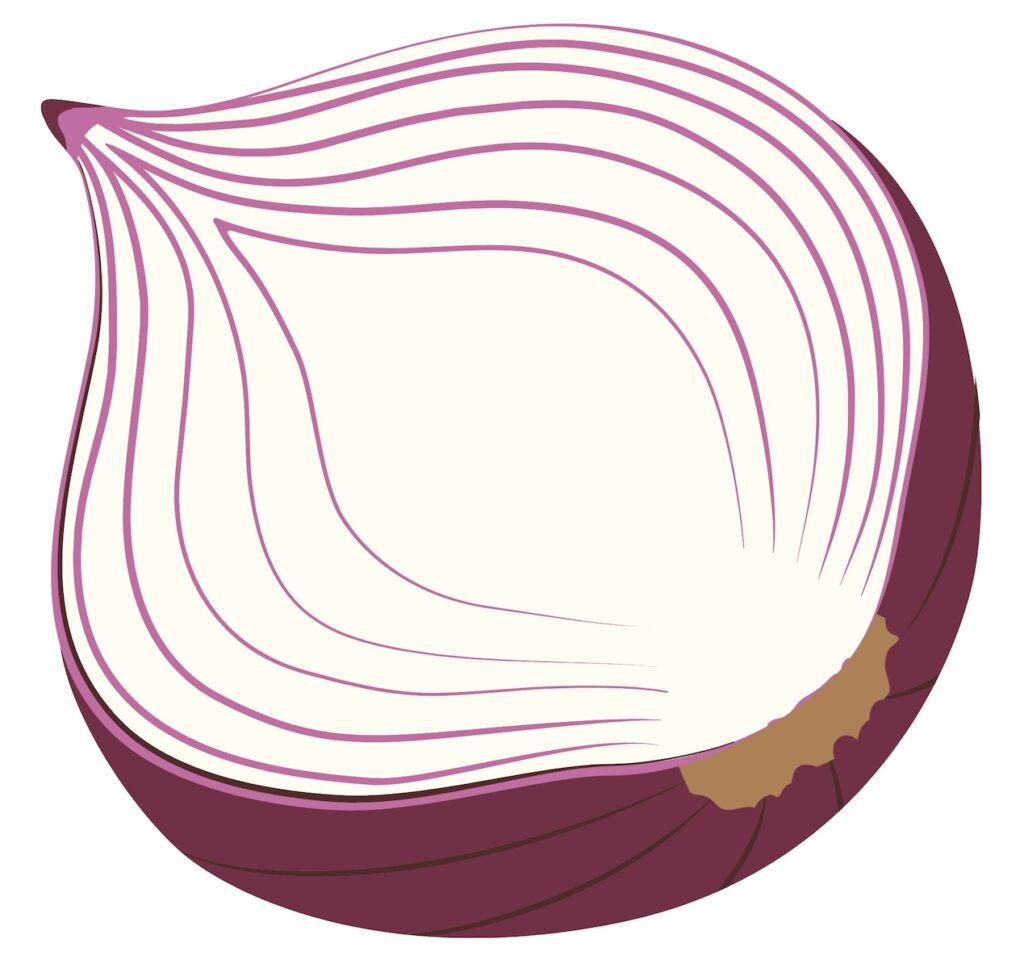
That one goes a little deeper—it’s about progress in waves. But even that never fully clicked for me. Because both of these ideas, while somewhat true, still made it seem like healing is supposed to feel endlessly confusing—and that clarity only comes way later, if at all.
A lot of people say, “That’s the process. You’re not supposed to understand it.” And sure, some uncertainty is part of the journey—especially at the beginning.
But I don’t think we’re meant to stay confused forever. The goal isn’t to wander endlessly in the dark. At some point, you start to see patterns. You start to understand. And that’s where the growth really deepens.
Healing doesn’t usually come from one big turning point.
It comes in layers, spirals, and echoes.
Maybe you read something that shifts your perspective just a little.
Maybe you talk to someone who names an experience you didn’t know how to explain.
You start journaling more honestly.
You hear a YouTube video that helps something click.
You travel somewhere and see your life from a wider perspective.
And over time, all those threads start to weave together.
That’s what healing has looked like for me.
Travel as a Catalyst for Inner Growth
Travel became one of the most powerful tools in that process—not because it gave me one big answer, but because it kept pushing me to grow.
Visiting ancient sites and learning how different cultures—especially indigenous and ancestral ones—understood life, death, healing, and transformation helped me see things differently. These weren’t abstract spiritual ideas; they were woven into daily life. The sacred wasn’t separate from survival—it was part of it. And that changed how I approached my own healing.
At the same time, being in those places in the present often stirred something complicated. It wasn’t always magical. In some places, I found myself grieving what had been lost—whether through colonization, erasure, or the passage of time. But I also found connection, hospitality, joy. I had conversations I’ll never forget. I saw beauty and complexity coexisting, both in the places I visited and in myself.
And beyond all that, solo travel itself became a teacher.
Learning how to navigate unfamiliar cities alone, deal with setbacks, and care for myself on the road built a kind of resilience I didn’t know I had. It forced me to slow down, tune in, and pay attention to what I needed—not just to get through the day, but to grow from it.
Somewhere along the way, I realized: travel isn’t a break from healing—it’s part of it.
But travel alone wasn’t enough.
Coaching helped me connect the dots.
Journaling helped me process the mess.
Self-care helped me find healing and recovery.
And over time, it all added up to something that felt like clarity.
Healing is mental, emotional, spiritual, and physical.
And different tools help at different times.
Travel opened the door—but everything else helped me walk through it with more clarity.
And that’s when the symbol of the labyrinth really clicked for me.
From Spiraling to Clarity
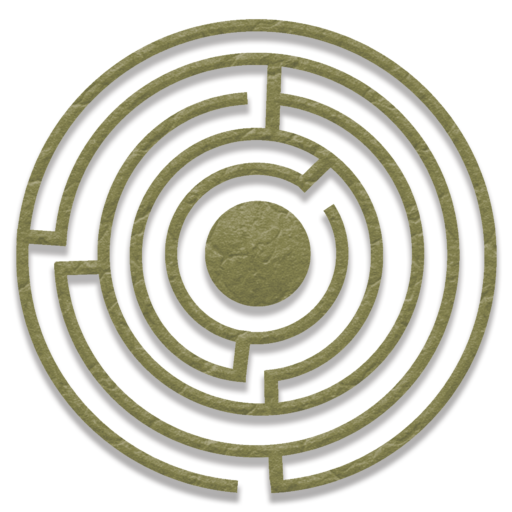
The labyrinth gave shape to the kind of healing I’d been doing all along: one step at a time, through spirals and setbacks, still moving inward even when it felt like I was going in circles (or even squiggly lines).
It said: You’re not lost—you’re just on the path.
You’re not going in circles—you’re going inward.
It’s not about getting “there” faster or escaping the messy middle. It’s about realizing the journey is the transformation. Every twist, setback, breakthrough, and return to the edge has meaning—even if you can’t see it fully yet.
For me, it took a long time for even the past to make sense. In the early stages of my healing, everything just felt confusing—what I’d been through, where I was going, why things kept falling apart. I couldn’t see any kind of pattern, only pain and frustration.
Eventually, little by little, the past started to take shape. I could look back and understand how certain experiences had shifted me, prepared me, or even protected me—sometimes in ways I didn’t realize at the time.
And now? I’ve started to feel that same clarity in the present.
Even when things are hard or uncertain, I can see how what I’m going through might be part of something meaningful.
I don’t just understand the journey in hindsight—I’ve started to trust it more often as I walk it.
Once I saw my journey through the lens of the labyrinth, everything shifted.
I stopped seeing my life as false starts—and started seeing a path with purpose.
Not a detour, but a design.
Ancient Origins and Cultural Connections
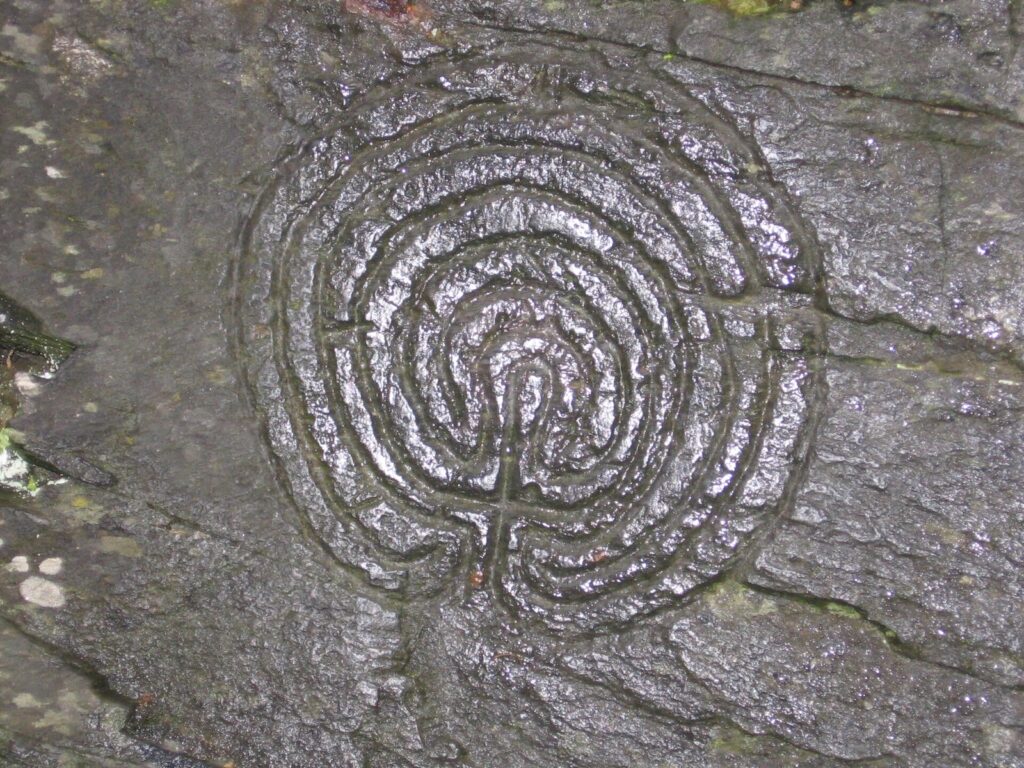
From the Greek myth of Theseus and the Minotaur to medieval pilgrimage routes in European cathedrals, to indigenous traditions in the American Southwest and ancient Hindu temples—the labyrinth has appeared across time, place, and belief. It’s not just a pattern on the ground. It’s a sacred space, a symbolic map of transformation, and a ritual of the soul’s journey through the unknown.
Whether carved into ancient stone or walked in silence through sacred spaces, the labyrinth has long been seen as more than a pattern—it’s a ritual, a story, and a mirror of the human experience.
In many of these traditions, the labyrinth isn’t just a journey—it’s an initiation. A descent into mystery, struggle, or darkness that ultimately leads to insight, clarity, or rebirth.
One of the most well-known examples of this is the ancient Greek myth of Theseus and the Minotaur.
Theseus and the Minotaur – Facing the Inner Monster
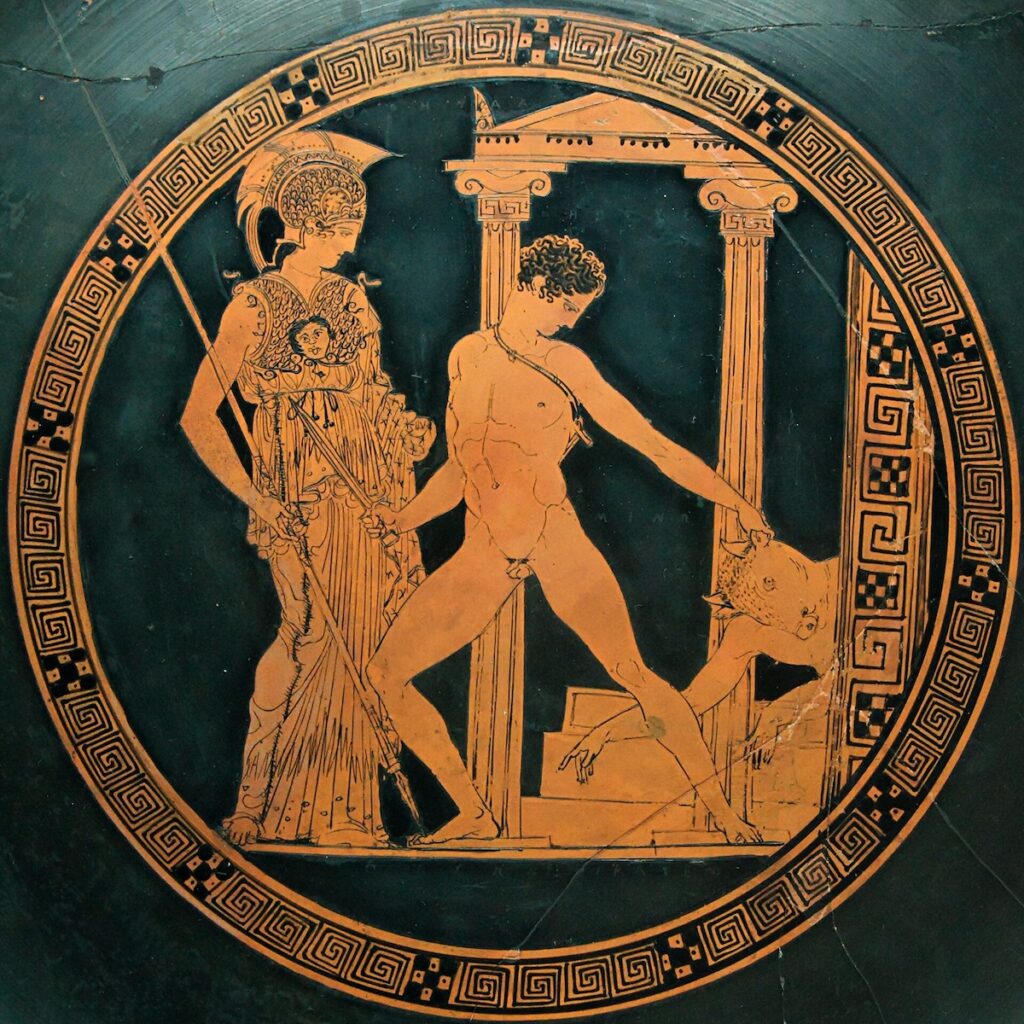
In Greek mythology, one of the most iconic labyrinth stories is the tale of Theseus and the Minotaur. According to the myth, the labyrinth was built beneath the palace of King Minos in Crete to contain the Minotaur—a terrifying half-man, half-bull creature. Every year, seven young men and seven young women from Athens were sent into the labyrinth as a sacrifice, doomed to be devoured.
Theseus, prince of Athens, volunteered to go—not to die, but to end the cycle. He entered the labyrinth determined to kill the monster. But he couldn’t just rely on bravery—he needed a way to get back out. Princess Ariadne, who fell in love with him, gave him a thread to unravel as he went in so he could find his way back once the battle was over.
And that’s what Theseus did. He followed the thread, fought the Minotaur, and emerged alive.
The symbolism here is rich and layered—and honestly, kind of brutal in how much it mirrors real life.
The Minotaur can symbolize what we’re most afraid to face—trauma, shame, illness, grief, or even the family legacies we didn’t choose but still carry.
The labyrinth is the container for that reckoning—where no shortcuts exist, and every twist leads deeper in.
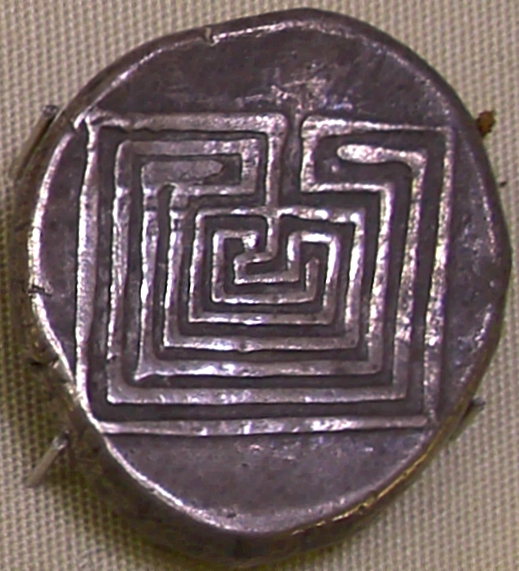
Theseus didn’t just walk in, kill the monster, and stroll out. He entered into a system designed to trap and destroy. He had to be resourceful. He had to trust something small and subtle (a thread!) to guide him back. The victory wasn’t just slaying the beast—it was making it back out with his sense of self intact.
And isn’t that what healing really is?
It’s not just about “overcoming.”
It’s about going into the darkest parts of your story and somehow making it back to the surface.
Not untouched—but whole.
The number seven, too—seven men and seven women—has deep spiritual significance across cultures. It’s often tied to completion, inner wisdom, and the idea of a full cycle. So in this myth, even the sacrifice itself points to something larger: the cost of ignoring your darkness… and the power of facing it head-on.
While the Theseus myth is one of the most iconic early Western references to the labyrinth, this archetype appears around the world—in carvings, rituals, sacred art, and spiritual practices that span continents.
And in every case, the message is similar: the way out is through.
Finding Meaning Across Time and Tradition
What’s fascinating is how the labyrinth didn’t stay confined to one culture. Even in traditions that might seem rigid or exclusive—like medieval Christianity—the labyrinth shows up, reinterpreted and reimagined.
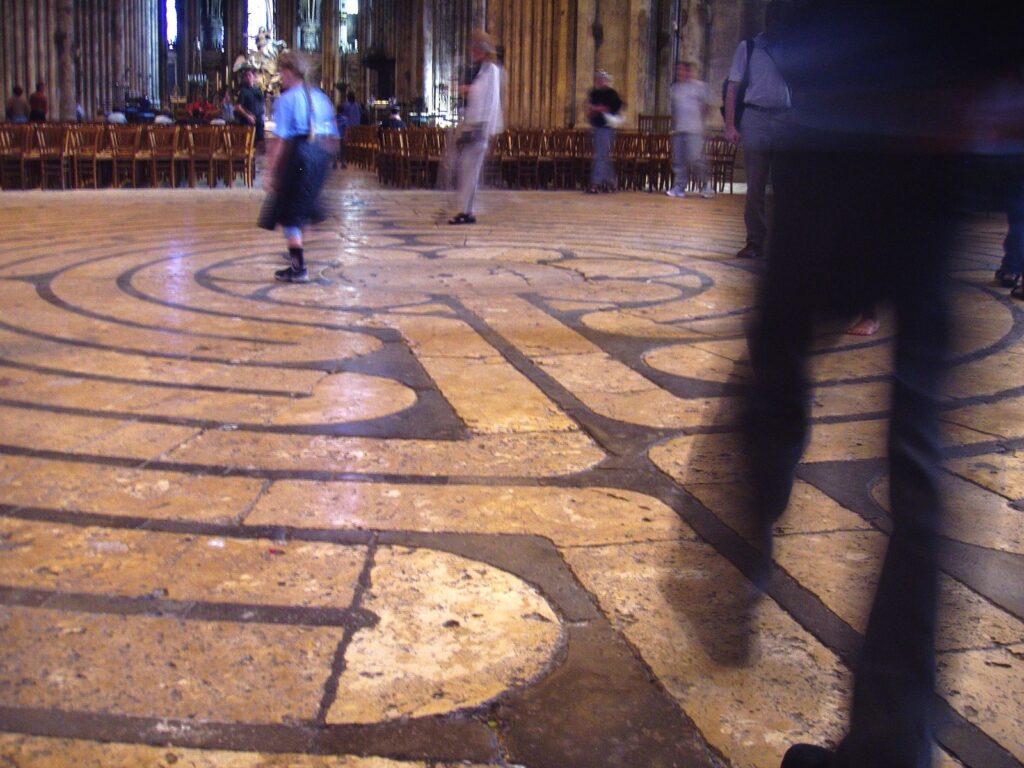
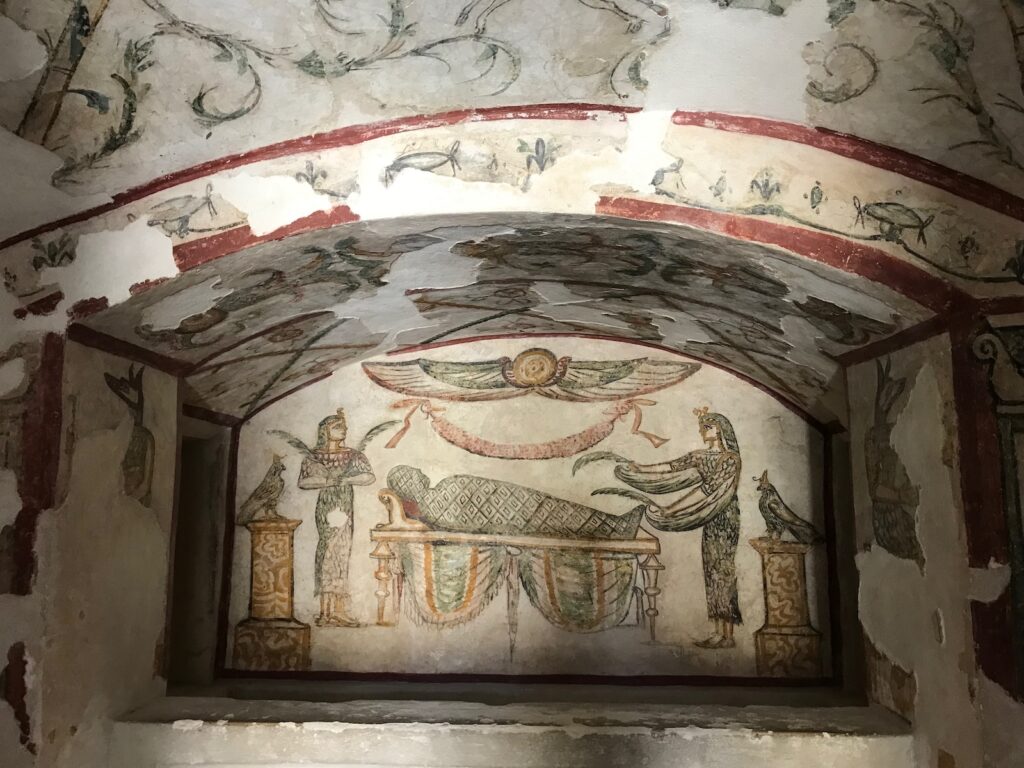
The famous labyrinth in Chartres Cathedral, for example, draws on Greek mythology while being centered in a deeply Christian sacred space. You’ll find similar blends in other places too—like synagogues with zodiac motifs in ancient Israel, or the Catacombs of Kom el Shoqafa in Egypt that merge Greek and Egyptian imagery.
Some people see this as appropriation or inconsistency. But I see something else:
Meaning doesn’t always come from the expected places. It’s often built from what came before. And if we let ourselves be curious and open, we can find deeper insight by learning how others have made sense of life’s hardest questions across time.
That’s the beauty of the labyrinth. It’s not about choosing one path over another—it’s about seeing that the path itself shows up in many forms. And the more we study, travel, and reflect, the more we realize: we’re not the first to feel lost or seek direction. People have been walking these spirals for centuries—literally.
One especially powerful example comes from North America. In the American Southwest, the Tohono O’odham people honor I’itoi—the “Man in the Maze”, a creator figure who fought mythic enemies before retreating into a spiral cave atop Baboquivari Peak. His symbol represents life’s twists, challenges, and choices. At the center lies wisdom. Though different from the Theseus story, the theme is familiar: the path is filled with struggle—and the center holds meaning.
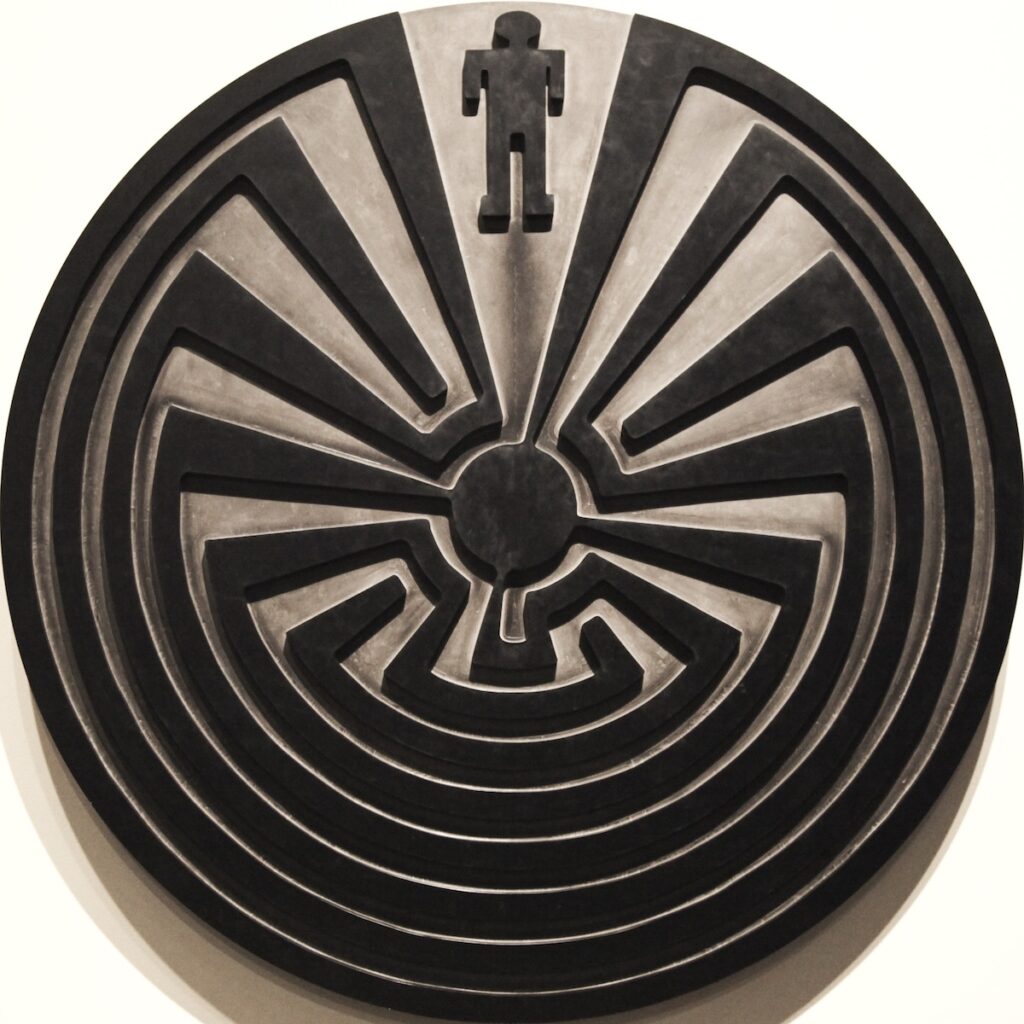
You’ll find echoes of the labyrinth across countless cultures: the sacred floor designs of Hindu temples, Celtic spiral carvings that speak of rebirth, and Neolithic labyrinths etched into ancient stone.
The designs may vary, but the message is remarkably consistent:
Life isn’t linear. And the path to meaning winds inward.
By exploring these patterns and stories across cultures, we see that the labyrinth isn’t just a spiritual tool—it’s a shared language. One that reminds us we’re not the first to walk confusing paths in search of something more.
Look closer at the myths behind these labyrinths, and you’ll start to see something familiar…
The Universal Pattern Beneath the Path
There’s always a descent.
There’s always a battle.
And at the center, there’s always something sacred.
☀️ In Greek mythology, Theseus enters the labyrinth to battle the Minotaur—a creature born of chaos and family trauma. The labyrinth’s symbolism is rooted in the Minoan culture, where the Minotaur was linked to the sun god, often depicted as a bull. This connection to the sun represents the struggle between darkness and light, with the bull symbolizing strength, vitality, and the power of transformation.
☀️ In the stories of the Tohono O’odham, I’itoi fights Yellow Buzzard and Coyote for the right to shape the world. The sun god plays a critical role in this myth, with I’itoi embodying the force of creation and illumination. After his victory, I’itoi retreats into a spiral cave, where offerings are made, symbolizing the light that nourishes growth and transformation.
☀️ In Christian tradition, pilgrims walked the labyrinth not just as a symbol, but as a spiritual trial—an inward journey to meet the divine. The labyrinth itself became a sacred space for reflection, an opportunity for pilgrims to connect deeply with their faith, experience personal transformation, and seek enlightenment along the path.
And in each case, it’s not just the monster or the labyrinth that matters. It’s what they represent.
The monster is the thing we’re most afraid to face.
The spiral is the path that makes us face it.
And the center is where the light breaks through.
Sometimes it’s the sun. ☀️
Sometimes it’s God. ☀️
Sometimes it’s just… you. The version of you that makes it through. ☀️
🐛🦋 The labyrinth is the chrysalis. The spiral of undoing and becoming.
What seems like going in circles is really becoming something new.
That’s why the labyrinth continues to resonate. Not because it’s an ancient design—but because it’s an eternal truth. The path may be winding, but the transformation is real.
Modern Uses: A Practice for Presence
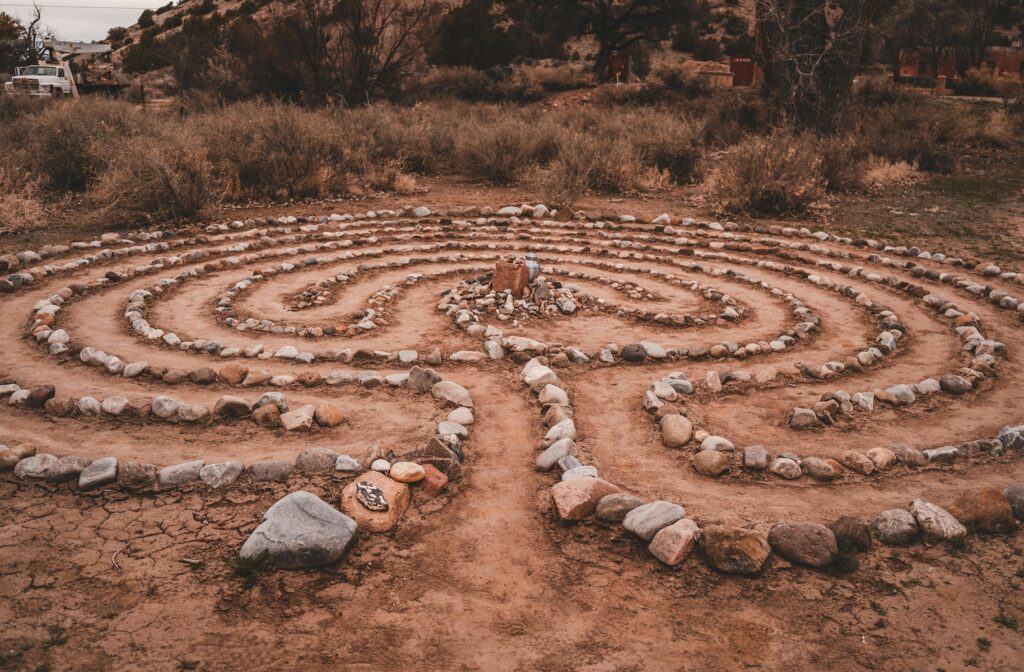
Whether you’re visiting an ancient stone labyrinth while abroad or walking a brand-new one behind a local hospital, the experience is still the same: one of presence, introspection, and quiet healing.
In recent years, more modern spaces—hospitals, parks, retreat centers, even universities—have rediscovered what many cultures have known for millennia: that walking a labyrinth offers something sacred. Not just calming, but grounding. Not just reflective, but transformational.
This isn’t about bringing back a trend. It’s about remembering something we forgot.
The labyrinth gives us a way to be fully present with ourselves—not in theory, but in practice. With each step, you’re invited to slow down and feel. To breathe. To stop performing or fixing and just be for a while.
Some use it to process grief. Others walk to prepare for something big, or to settle back into themselves after burnout. It’s been used for prayer, for ceremony, for transitions of all kinds. And for solo travelers especially, it can become a ritual—a sacred pause in the middle of movement.
The more I’ve learned about the history and symbolism of labyrinths, the more meaningful they’ve become. Across cultures and centuries, they’ve reflected something I hadn’t found in squiggly graphs or onion metaphors: a journey filled with purpose, direction, and ancient meaning.
Unlike a maze, a labyrinth has only one path. You can’t get lost. You might feel far from the center, discouraged, or unsure of where you are—but you’re still moving forward. Still on the path. That truth alone has reshaped the way I see my own journey.
You don’t have to walk a physical labyrinth to understand its wisdom. But if the symbol has resonated with you—or you’re simply curious—there are places where you can actually experience one for yourself.
From ancient spiritual sites to hidden corners of cathedrals, and from sacred land in the American Southwest to peaceful outdoor spaces around the world, these labyrinths offer a chance to slow down, reflect, and walk with intention.
Here are just a few places in the US and abroad where you can find labyrinths to walk—some rooted in ancient traditions, others built in quiet reverence to honor that same journey inward.
Want to Walk a Labyrinth? Here’s Where to Start
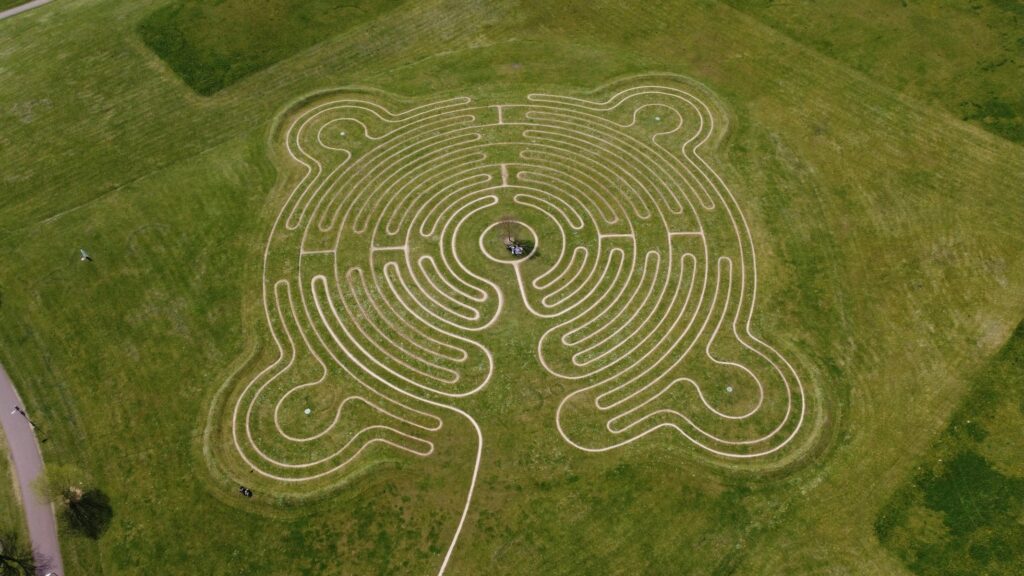
If you’re drawn to the symbolism of the labyrinth, there’s nothing like walking one in person. From ancient cathedrals in Europe to energy-rich landscapes in the American Southwest, these destinations offer powerful places to slow down, reflect, and reconnect.
Some are centuries old, steeped in tradition. Others are part of modern retreat spaces designed for healing and presence. But they all invite you into the same quiet truth: the way forward is found by walking inward.
🇫🇷 Chartres Cathedral – France
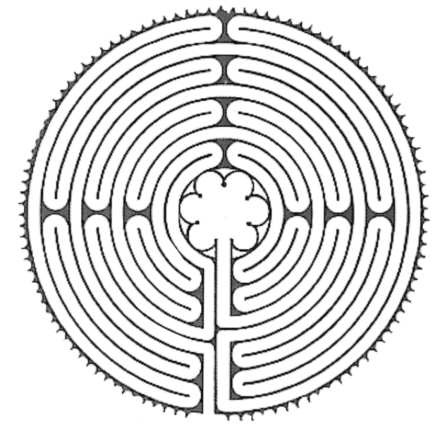
This 13th-century labyrinth is set into the stone floor of Chartres Cathedral, just outside Paris. Originally used as a symbolic pilgrimage during the Middle Ages, it’s now one of the most iconic and spiritually rich labyrinths in the world. Visitors still walk it today in reverence and reflection.
🌿 Make this more than a trip — make it a turning point.
Grab the Deeper Travel Planner to map out a soulful solo getaway built around rest, reflection, and renewal.
🇺🇸 Grace Cathedral – San Francisco, CA
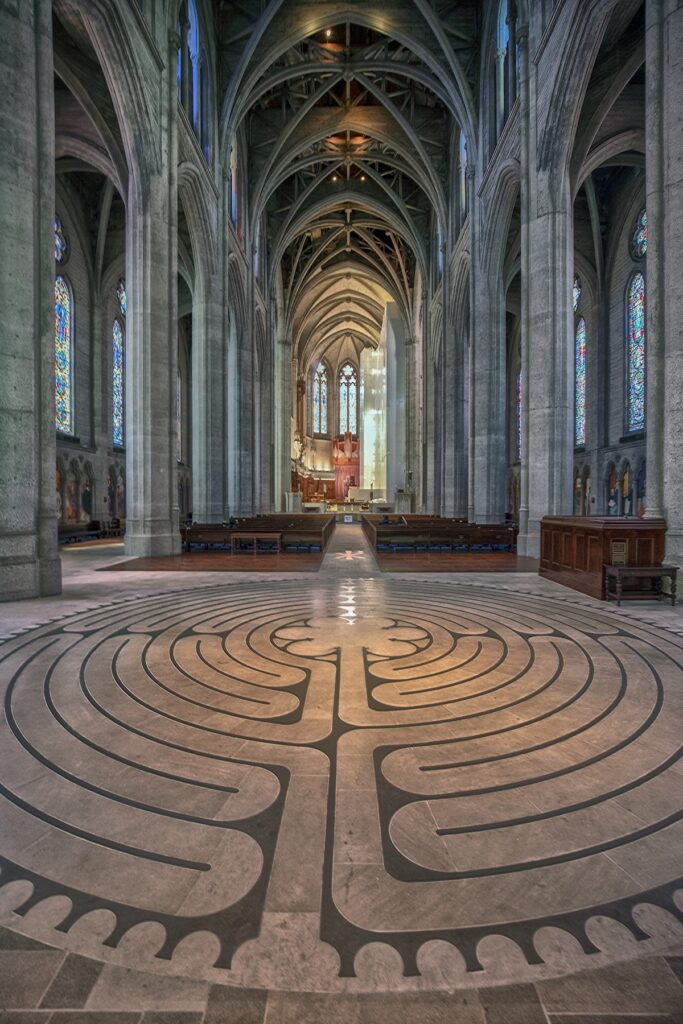
Inspired by Chartres, Grace Cathedral features both indoor and outdoor labyrinths open to the public. Whether you’re attending a service or simply seeking a quiet moment, this urban sanctuary offers a rare blend of spiritual history and modern accessibility.
🇨🇷 Tamarindo Labyrinth – La Senda, Costa Rica
Tucked away in Costa Rica’s lush Guanacaste region, the Tamarindo Labyrinth at La Senda is considered the largest labyrinth in the world. Its nearly 2-mile path winds through over 5,000 carefully planted cacti and is designed around the sacred Vesica Piscis geometry—symbolizing balance, healing, and the merging of dual energies. This meditative walk is part of a larger eco-conscious retreat center offering wellness experiences rooted in nature, intention, and deep connection.
🇺🇸 Sedona, AZ

Famous for its vortex energy and red rock landscapes, Sedona is also home to several labyrinths—some nestled within retreat centers, others open to visitors. Here are a couple examples:
- Amitabha Stupa and Peace Park is a sacred outdoor space where quiet trails and meditation areas invite you to reflect and reconnect.
- Angel Valley Retreat Center offers multiple labyrinths and spiritual walking paths for deeper reflection.
🇬🇷 Knossos Palace – Crete, Greece
This ancient Minoan palace is often linked to the myth of the Minotaur’s labyrinth. Though there’s no physical labyrinth on-site, the sprawling, maze-like ruins and mythological ties make it a powerful place to reflect on the roots of labyrinth symbolism—and how the myths we walk through can shape our journey.
🇪🇸 Mirador del Laberinto – Barcelona, Spain
Tucked into Parc del Laberint d’Horta, this 18th-century neoclassical labyrinth is a peaceful spot just outside the city center. It’s not spiritual in origin, but it invites a playful and reflective experience—and proves that labyrinths, even decorative ones, can slow the mind and engage the senses.
🇲🇽 Teotihuacan – Mexico
Though not a traditional labyrinth, this ancient city’s ceremonial layout mirrors the cosmic journey of the soul. Walking the Avenue of the Dead, ascending the pyramids, and exploring the complex geometry of the site can feel like a spiritual initiation. It reflects a similar archetype: ascending through sacred space to connect with higher truth.
🇮🇳 Rani Ki Vav – Gujarat, India
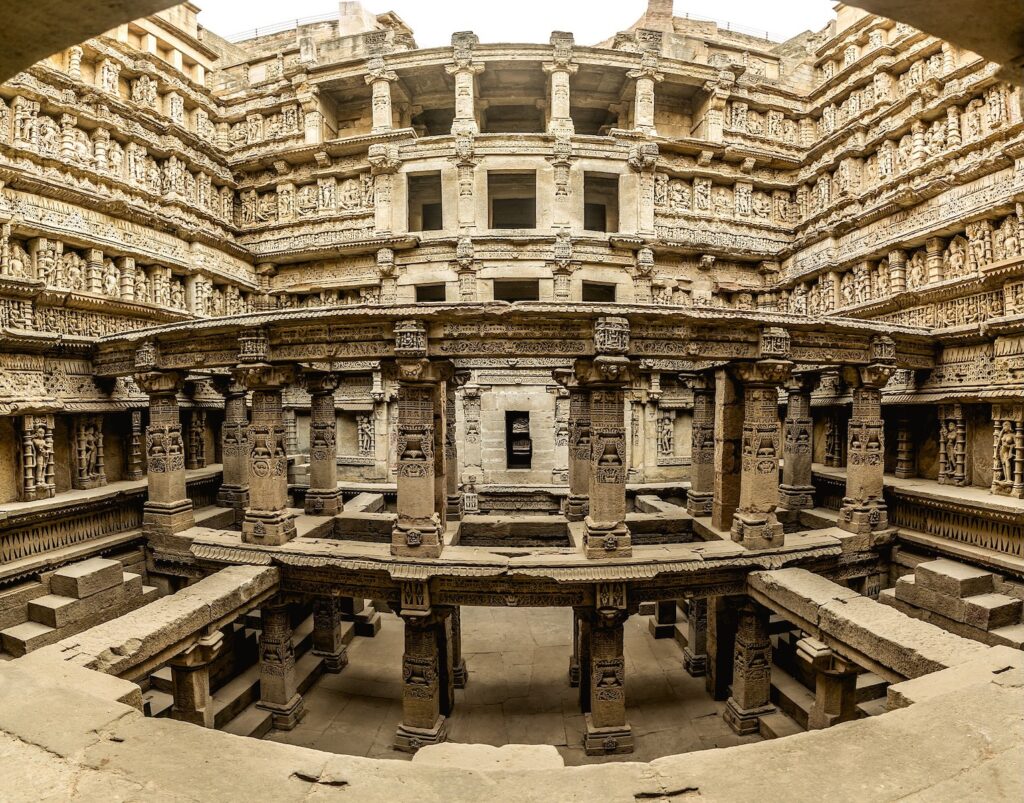
This stepwell and temple complex features sacred geometry and layered passageways that evoke the symbolism of labyrinths. While not a classical labyrinth in design, it embodies the concept of descending into the earth to emerge spiritually renewed—a key theme in labyrinth symbolism.
🇮🇪 Newgrange – County Meath, Ireland
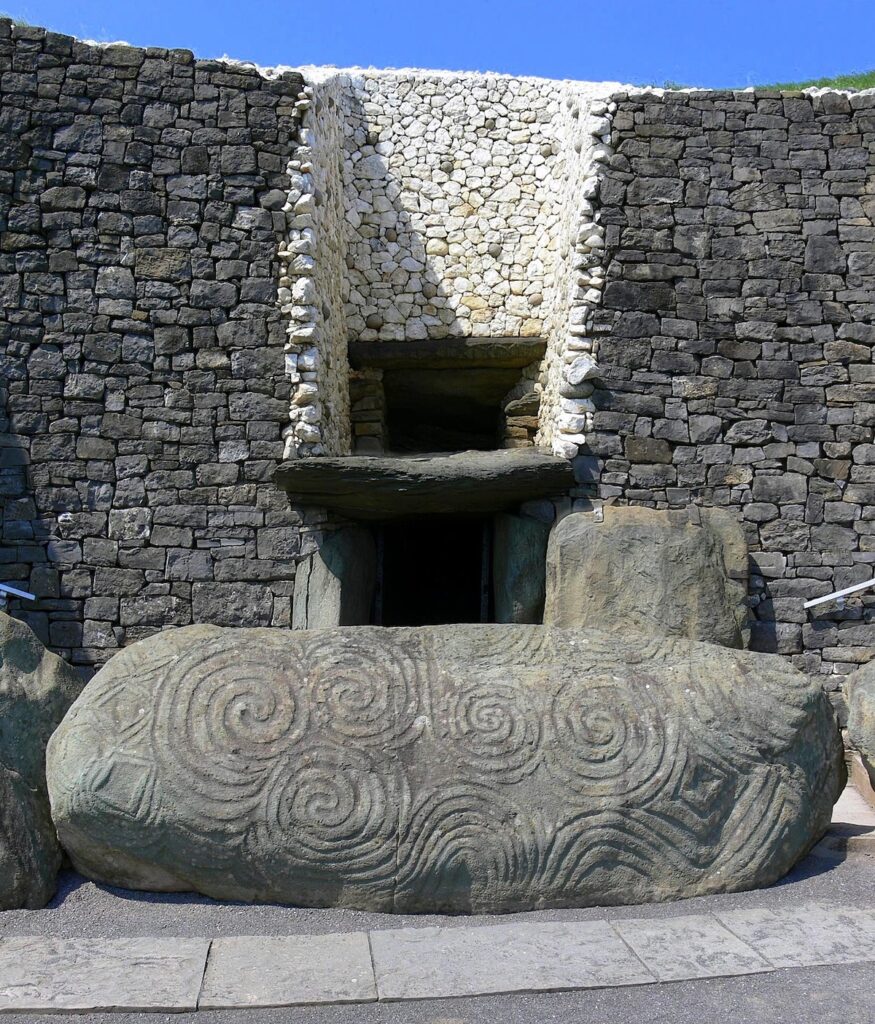
Older than Stonehenge, this Neolithic site is etched with spiral motifs that may have symbolized the cycles of life, death, and rebirth. Though not a walkable labyrinth, the energy and intention echo the inner journey.
🇫🇷 Ariège Stone Labyrinth – France
Found in caves and on stones in southern France, these ancient spiral carvings are some of the oldest known labyrinth-like designs. They speak to a deep, prehistoric connection to the soul’s journey inward.
Each of these places reflects the power and persistence of the labyrinth as a sacred symbol. Whether ancient or modern, built from stone or imagined in spirit, the path remains—waiting for you to walk it.
🌀 Final Thoughts: The Journey Inward

The labyrinth teaches us that movement doesn’t have to be fast to be meaningful. That stillness isn’t stagnation—it’s part of the path. That even when you feel far from your center, you’re still moving toward it.
Wherever you are—traveling the world, healing from something heavy, or just trying to find your footing again—the journey inward is always available. You don’t have to see the whole path. You just have to take the next step.
🧭 Ready to go deeper?
The Power of Four is a $7 e-book that weaves together ancient wisdom, symbolism, and modern healing through the lens of the elements.
If the labyrinth spoke to you, this guide expands on the same themes—helping you map your personal transformation through earth, water, air, and fire.
It’s a soulful, self-paced read with journaling prompts, symbolic stories, and travel-inspired insights to walk your path with more clarity.

📌 If this post sparked something for you, feel free to pin it for later — your future self might thank you.
💬 Want to keep the conversation going?
Join other solo travelers in the Facebook group » to share thoughts, stories, and


